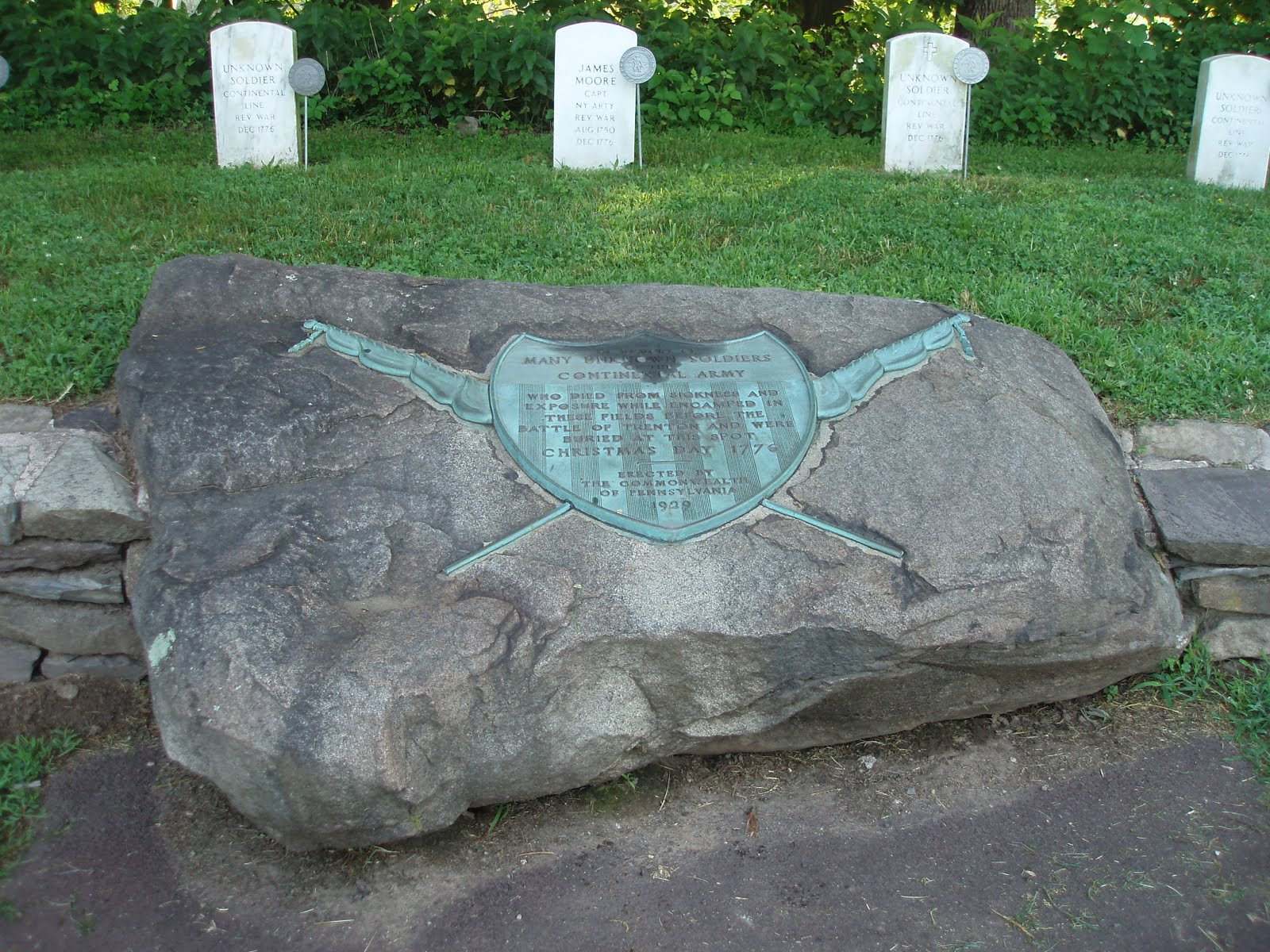
Christmas Crossing, 1776
Christmas Day marks an anniversary in our great American experiment, one that was a true turning point in our national fight for independence and self government, launched nearly 6 months after the Continental Congress had cast the final die for liberty in Philadelphia, with the signing of the Declaration of Independence.
A mere 235 years ago today, on Christmas Day night, December 25, 1776, in the face of a howling nor'easter snowstorm, the Virginia commander of a largely defeated and demoralized New England-based army, General George Washington, and his able officers led the consolidated remnants of the Continental Army -- 2,400 troops, 18 cannons, a number of horses, and other supplies -- in an audacious and surprise fording of the ice-swollen Delaware River at McKonkey's Ferry in Pennsylvania, a little over 8 miles north of the British cantonment at Trenton, a fortified encampment occupied at the time by widely-hated Hessian mercenaries.
The British occupiers had settled into several in a loose chain of strategic defensive locations across New Jersey for the winter, including at New Brunswick, Princeton, Trenton, as well as down in Bordentown and Mount Holly. The eventual target of the British forces, of course, was the American Continental Congress in Philadelphia.
Having succeeded in making that improbable Christmas crossing (the only successful one of three that were planned for that night), the cold and exhausted Americans, many of them without adequate footwear, marched south over night, and surprised the Hessian troops right in their Trenton encampment, decisively won the day, and then retreated back to the Pennsylvania side with critical captured stores, and as many as 1,000 prisoners.
At Trenton, following that quick and decisive action, General Washington reputedly remarked to one of his top aides:
"Major Wilkinson, this is a glorious day for our country."It was the first field victory for the Continental Army after a string of stinging defeats in and around New York City, following the massive British troop occupation of New York in the summer of 1776. That string of setbacks had eventually precipitated a full-fledged retreat of the dwindling remainder of the American army across New Jersey on the heels of their defeat at Fort Lee.
They escaped into Pennsylvania via the Delaware River at Trenton in very early December. The British meanwhile had secured full control of New York City and the immediate environs, which they would hold throughout the remainder of the Revolutionary War.
Less than one week following his surprise victory at Trenton, and mindful that he was about to lose the lions' share of his American enlistments -- they were running out as of the beginning of January -- Washington and the Americans repeated their audacious crossing, this time at a few points along the freezing river on December 29th and 30th, after which they eventually set up defensive positions behind a stone bridge that crossed the Assunpink Creek, including heavy earthworks, all of which they knew would inevitably draw in a heavy British response from the New Brunswick and Princeton garrisons.
On the 31st of December, it was there in Trenton that first Gen'l Thomas Mifflin, and then Gen'l Washington himself, made strong personal appeals to the various regiments of enlistees who were about to head home, pleading with them to reenlist in the cause, and giving out generous bonuses. At first hesitating, most eventually responded positively.
Alerted to the renewed presence of the of American troops and artillary back in Trenton, Lord Charles Cornwallis had marched a massive force from New Brunswick down to Princeton, arriving there on New Year's Day. And then he moved onto to Trenton, where eventually a large force of 5,000 men under his command was to attempt to engage Washington's army in their defensive positions in the "Battle of the Assunpink Creek," or, "The Second Battle of Trenton.
That Christmas victory in Trenton had changed the mood, not only in the confidence of the American troops, but also of the various militia units, and even of the people in the countryside. The British force under Cornwallis was constantly attacked and harassed during their march to Trenton, by both Continental Army forces under Col. Edward Hand, and others near what is today Lawrenceville.
The British force eventually arrived in Trenton, above the bridge across the Assunpink on the afternoon of January 2nd. And after undertaking a series of unsuccessful attempts to cross, during which they took considerable casualties, they disengaged from that late afternoon attack for the remainder of the night. The determination was made to attack and cross the contested bridge at first light, mistakenly thinking that they would thereupon finally force the surrender of the trapped rebel army.
But stoking their fires and encampment late into the night as a diversion, Washington's Army held a council of war, and instead quietly mustered in the very early morning hours, and they took a back road out of the supposed "trap," a route that was unknown to the British forces. Aided by ground that had frozen hard, the American forces crept right around those massed British forces, including those Cornwallis had left as a rear guard along the main road north. Gen'l Washington's army marched north, even building a quick bridge over a stream for their artillery along the way through Quakerbridge, and on they marched the several miles to eventually engage and achieve victory in a surprise attack on the skeletal British forces remaining in the Princeton area the next morning.
At one point, Gen'l Washington had to take personal command of the battle action in the fields south of Princeton, during an engagement in which Gen'l Hugh Mercer, a close friend of Washington, was mortally wounded. At great personal risk, Washington rallied the faltering American troops, who finally succeeded in routing the British. Gen'l Sullivan, meanwhile, entered Princeton and forced the surrender of a small British force at Nassau Hall. The Americans had achieved a face to face field victory over British troops. The American forces gathered up more stores and supplies in Princeton, and then they all headed north, up through Rocky Hill, and out toward Morristown, while Cornwallis withdrew toward New Brunswick.
In a matter of a little more than a week, Gen'l Washington and his troops had defeated the British in three engagements, along or near the Delaware.
The big picture was that the Howe brothers' military strategy of patiently ending the "rebellion," by defeating the American force through attrition, and thereby reestablishing colonial control - essentially by default, had been exposed and defeated by Washington's Army. The British withdrew back toward New York, where they would subsequently mount an offensive by sea against Philadelphia the following year.
Eventually, of course, it would be the British forces who would be defeated by attrition, though it took several years.
Seven years later, in 1781, just following the Battle of Yorktown down on the Chesapeake, Lord Cornwallis was reputed to have honored the victorious General Washington at an officers event, held a few days following his surrender, with a toast in the following words:
"[T]he brightest garlands for your excellency will be gathered not from the shores of the Chesapeake but from the banks of the Delaware."
Labels: Assunpink Creek, Christmas crossing, Continental Army, Declaration of Independence, Delaware River, General Cornwallis, George Washington, Howe brothers, McKonkey's, Princeton, Trenton
posted by Trochilus @ 12/25/2011 01:06:00 PM
0 comments